Off Grid Microhydro Power Generation Backyard Hydro Power
Microhydro, is a dam-less backyard hydro power generator you can use to generate residential off grid or grid-connected micro hydro power by harnessing a low head water stream. It is a cost effective way to generate clean energy day and night year around.
History and Background of Hydro Energy
Water mills (as well as wind mills and oxen driven mills) were known and used for many centuries. With the advent of steam engine and later on electrical powered motors mills were modernized; modern mills are driven by electrical motors. People however, did not neglect the enormous power the streaming down hill water have . Damming the big rivers to keep water reservoirs and produce hydroelectric (In Greek hudor is water) power is done everywhere. When we hear hydroelectric our immediate association is the big mega-projects like the Hoover dam (on the Colorado river) or the Aswan dam (on the Nile river). We tend to neglect the modest stream that we might have in our backyard, a treasure that might supply hydro energy for the home we live in. Needless to say, if you live on grid it is unlikely there is a stream in the urban or suburban area that can be exploited. So, microhydro power is most likely an off grid power solution
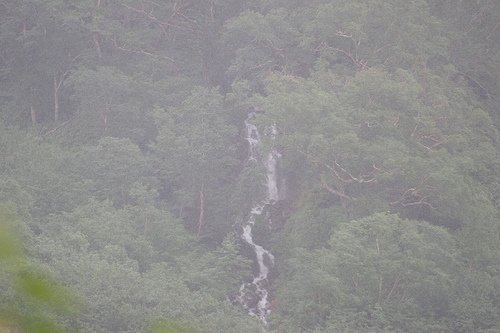
Picture attributed to mrhyata
Think small (microhydro), think clean energy (electricity)
An off grid home owner that has a stream of water near by, maybe not as impressive as the one shown in the picture may consider to harvest the water energy to produce electricity. The capital expenditure will be a fraction of the needed investment in offgrid solar power and in most cases less than the expenditure in off grid wind turbine. Since water rushes down hill day and night year around, the needed deep cycle storage batteries capacity is minimal, less than what is needed for solar and wind generators. Relax, watch the video, listen to the water, I'll explain after the video section the principle of operation.
Microhydro Power Generation Principle of Operation
Back to physics; a mass of water rushes from higher altitude to lower altitude is converting potential energy into kinetic energy (the energy any mass has when it is in motion). Try to block the stream with a wall, pressure can be built up to spill over the wall (water regained potential energy); try to put light object or heavy log on the water and the water will take it downhill. The video showed a mountain stream; some of the water were filtered and entered a pipe, the water flew in the pipe and drove an electrical turbine that generated electricity. The water pressured the turbine blades; the pressure is proportional to the “head” (the difference of elevation between the upstream beginning of the pipe and the downstream turbine). Some “head” is wasted due to the friction between the water and the pipe. The amount of electricity that can be generated is proportional to the head and to the amount of water in a unit of time (gallon per minute, liters per minute, etc.)
1 cubic feet per second = 450 gallons per minute = 28.3 liters per second
static pressure of 1psi = 2.3 feet of head = 0.7 meters of head
Available Power (watts) = Net Head (ft) x Flow (gallons per minute) / 14
See the rating in the beginning of the video to get a sense of a production capability; static head is 55 meters (180 feet), flow rate is 20 liters per second (320 gallons per minute), peak production is 3,000 watts.
Shopping list for off-grid Microhydro system
Filter and pipe intake (might exist already for irrigation)
A pipe + plumbing + valves (they might already exist for irrigation purposes)
A small Turbine (generator)
Electrical panel, meters, a control system, etc.
Wires
Turbine Generator types
There are different types of generators:
DC generator (the preferred alternative); A DC generator requires a charge controller and deep cycle batteries; the generator is sized to fit the average household consumption; view my page on off grid solar system sizing to see how to size the system and batteries. A DC type turbine synergies well with off grid solar and off grid wind turbine
AC generator, an AC generator is sized to fit the peak household consumption; therefore, a dump load is needed (electric water heater or space heater) into which the excess production capacity is shunted.
For the rare cases of grid connected homes and ranches, AC generator is preferred, the batteries are not needed (the grid is the backup), and the size can fit the average household consumption
Water turbines and wind turbines must have a load that draws current, working into a no-load condition (open circuit) will cause the generator to rotate faster than what it was designed to and to break down. A diversion controller (load controller) monitors the load condition and divert excess current into the dump load to heat it up. The dump load could be a resistor, an incandescent bulb or even better a useful load such as a hot water heater, or an air heater.