


|
Types of Solar Water Heating SystemsThis is an overview of the different solar water heating systems types. The different types differ according to the geographical region (sunny or cloudy), installation details (tank bellow or above the collector) and the liquid that is circulated between the tank and the collector. Water (direct solar powered water heater) is not used if the temperature drops bellow freezing point; glycol (indirect solar energy water heater) is used instead. The price of the solar energy water heater is dependent on its size and on its type. Even if you need to invest in the most expensive type having the evacuated tubes solar water heater this investment is one of the best you can make and it will be paid back in a matter of few years.
The Passive Solar Hot Water HeaterThe lowest cost type is the passive solar heating system. It consist of only 2 elements, the flat plate collector and the hot water tank. The collector is flat plate solar collector. It is an insulated sealed flat rectangular casing. The bottom plate is covered with a thin black absorber sheet. Above this sheet there is a meander of thin pipes running water in a loop to the tank. The top is made either from a glass or from a polycarbonate (transparent polymer) sheet. The hot water storage tank is an insulated reservoir for hot water. In most cases it is equipped with an auxiliary heater to serve in cloudy days. The auxiliary heater is automatically turned on when needed. The passive solar energy water heater is perfect for sunny regions such as the sun belt states in the South West. The tank must be installed in a higher position than the collector. This type is the least expensive. The Active Solar Hot Water Heater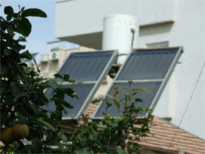
The medium cost type is the active solar water heater. An active solar water heating system consists of 3 major elements, a flat plate solar collector,and a solar energy hot water pump. This system is used if the tank is bellow the collector (e.g when concealed under a slanted roof). The collector and the tank are the same as those described above for the passive system. There is variety of available pumps, operating from the grid AC supply, from DC batteries or from a small photovoltaic panel generating DC power. For mild weather with no freeze threat the fluid used in the loop between the collector and the tank is water (this is an open solar energy water heater system or direct system) A more expensive alternative for cold weather with occasional freezing is to use an anti-freeze fluid instead of water. (this is called closed system or indirect system) If anti-freeze fluid is used, a solar heat exchanger must be used. A thermostat is used to stop the circulation of the liquid (water or glycol) once its temperature reaches an upper safety limit.
For active solar water heating system (equipped with a pump), the collector can be installed higher than the storage tank or in any other desired position. Typical situations are indoor tank (typically in the attic), concealed tank or a condo installation. Because the active system is more complex than the passive collector system, there is usually a need for a controller to turn on or off the different components as needed.
The Evacuated Tube Solar Water HeaterEvacuated tubes solar water heaters are the second generation of solar energy water heaters. Solar Evacuated Tubes Collectors, unlike the first generation Flat Plate Collector, use a group of cylindrical shaped solar collectors. Evacuated Tube Solar Collectors are more efficient and are used in colder, cloudy, northern higher altitudes states. They are able to capture sun radiation from many more angles because of their circular shape. They can collect sunlight earlier and later in the day, when the sun is at lower altitude angles. They exhibit more collector aperture area, allowing better efficiency in lower light conditions, typical to northern areas. The extra cost of Evacuated Tubes Solar Collectors doesn't justifies installing them in mild and warm regions. A (usually indoor) hot water tank and a pump complete the system. The fluid in the loop between the tank and the collector is anti-freeze fluid and a heat exchange is needed, usually an integral part of the tank. Here is a perspective drawing of an early construction of Evacuated Tube Solar Collector 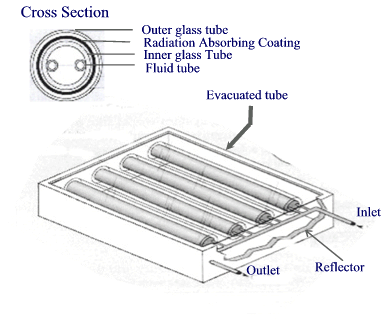
Buying and Installing Solar Hot Water HeatersYou can get a turnkey proposal from a solar contractor, or you can Do It Yourself (DYI); DIY can be done the easier way by buying the DIY solar hot water kit from a store you can trust and then install the kit. Compare the solar kit price to the turn key job price. For more details click to view my page on DIY solar hot water systems
click to view my page on solar water heater design dependency on application and region The ICS Solar Water HeatingThere is one more type, not in the main stream. It is the simplest and the lowest cost. It is the ICS Solar Water Heating, also known as the batch solar collector. It fits best to small families (1-2 people) in the Sun Belt states. It integrates the water storage functionality into the collector, making it a very cost effective solar hot water heater system.
click here to find out how to size your water heating system click here to see a general overview of solar hot water heaters click to view my Home Page
Copyright 2009-2012 solar-energy-for-home.com |

This site for sale, affordable price
click to contact me for details



click to search the content on this site